 Webbify Studio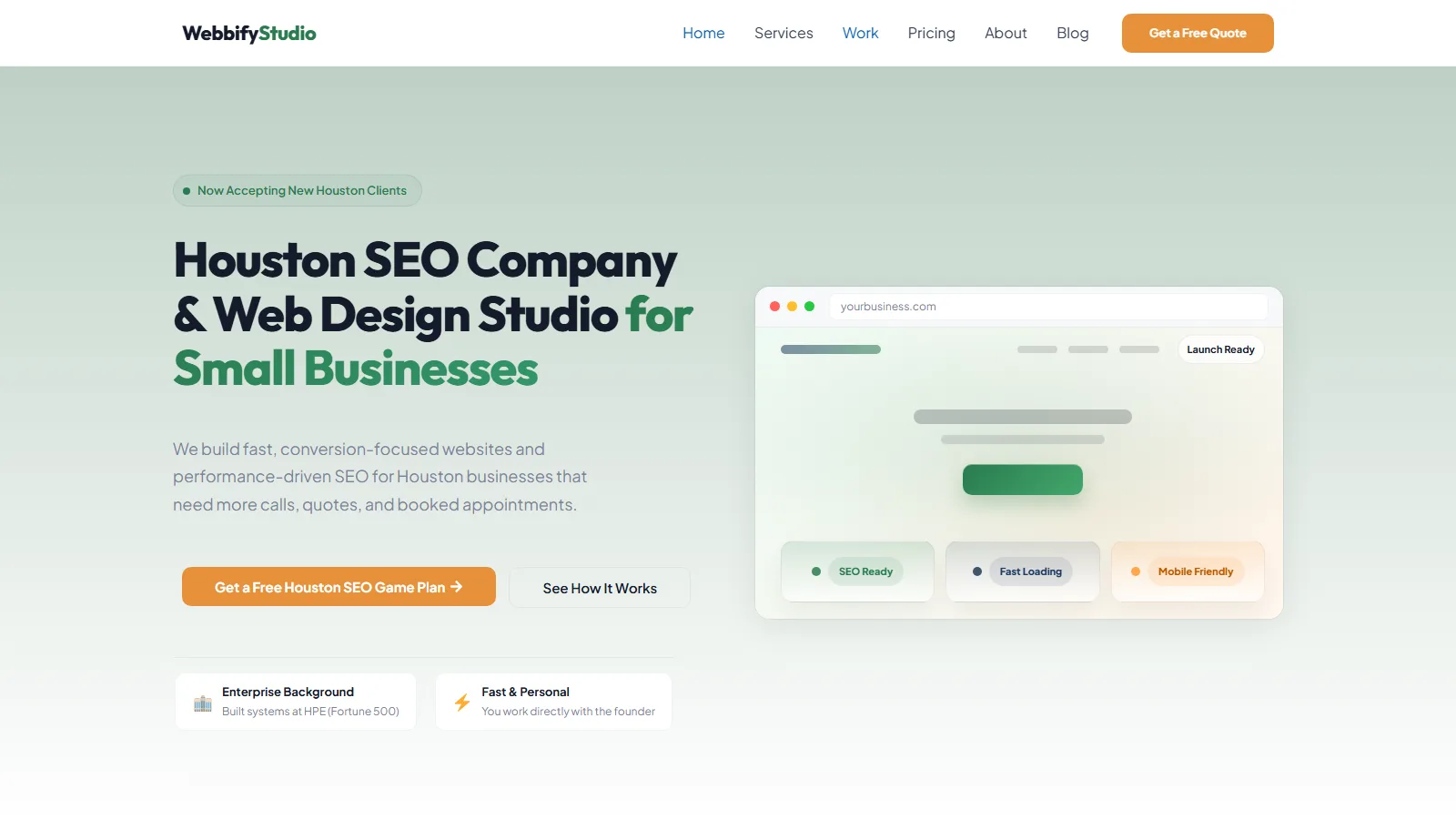
- Status
- LiveShipped and publicly available.
- Started
- Updated
- Role
- Founder, Web Development, SEO Strategy, Client Delivery, Analytics, Product & Technical Direction
- Built with
Overview
Webbify Studio is the web-development and SEO business I run through Lehrer Group LLC, focused primarily on Houston and Greater Houston businesses.
I started it as a client-services operation, but it became a broader experiment in how small-business websites should be built: research the market first, structure the site around real search intent, and treat design, development, analytics, conversion, and SEO as parts of the same system.
The work spans very different clients. Lily Lane Aesthetics required a visually sensitive, mobile-heavy treatment website. NanoVapor raised a more strategic question about whether the site should market equipment or the industrial service customers were actually searching for.
Those projects shaped how I approached Webbify itself.
Search Architecture Before Page Count
Most small-business website projects separate decisions that are tightly connected.
A designer creates the layout. SEO is added later. Service pages are written without understanding how customers search. Analytics arrives at launch.
I wanted to reverse that order.
The business problem and search opportunity should influence page hierarchy, content, internal linking, schema, calls to action, and implementation from the start.
For Webbify’s own site, I assembled Houston-area search data and used it to shape service clusters around web design, website development, redesign, local SEO, SEO consulting, and related intent.
The important lesson was not to turn every keyword variation into another thin page. Terms increasingly get grouped by actual user intent and separated only when the service, audience, or problem is meaningfully different.
Client Work Changed the Operating Model
Webbify also taught me that a technically successful site can still be a poorly managed project.
Lily Lane began as a relatively small fixed-price Squarespace/SEO engagement and expanded into roughly 200 hours of work, custom responsive design, much deeper treatment architecture, staging, and migration.
That became a concrete lesson in scoping, change orders, and pricing.
The migration itself reinforced another point: a WordPress site is not just the database. Assets, uploads, custom CSS, JavaScript, configuration, and hosting state matter too. The final migration preparation included both database and filesystem backup rather than treating one SQL export as the site.
NanoVapor produced a different lesson. Search research changed the positioning itself, moving the website away from emphasizing the ST-1000 equipment and toward the higher-intent service problem of underground storage tank degassing and vapor removal.
SEO was not just optimizing the copy; it was informing what the business should foreground.
Webbify as Its Own Product
The public Webbify site grew beyond a five-page agency brochure into a deeper Houston structure with roughly 20–22 individually optimized pages, service hubs, portfolio content, structured data, and supporting internal links.
In parallel, I built a separate Astro-based version locally as a faster, code-first publishing system with reusable components and shared design tokens.
That repository later became a real-world dogfood site for RouteWarp, another tool I was developing. The connection is useful: the agency work produced the website-maintenance problems that inspired RouteWarp, while the Webbify codebase became one of the places where RouteWarp could be tested.
Current State
Webbify Studio is an active public business with live client work and a public website.
Its Houston service architecture is built and multiple pages have been indexed, but competitive non-branded rankings are still developing. I do not treat indexing as equivalent to ranking success.
The current priorities are stronger authority signals, internal linking, defensible case studies, recurring SEO work, and deciding when the local Astro architecture should become the production publishing system without sacrificing the operational advantages or search equity of the existing site.
Milestones
Houston search architecture expanded
Moved Webbify beyond a small agency brochure into a deeper service and location publishing structure.
Client-services work established
Active client delivery included website restructuring, SEO, staging, and direct project ownership.
Code-first Astro rebuild developed
Built a separate maintainable static-site version that also became a realistic RouteWarp dogfood target.