 VetCaseIQ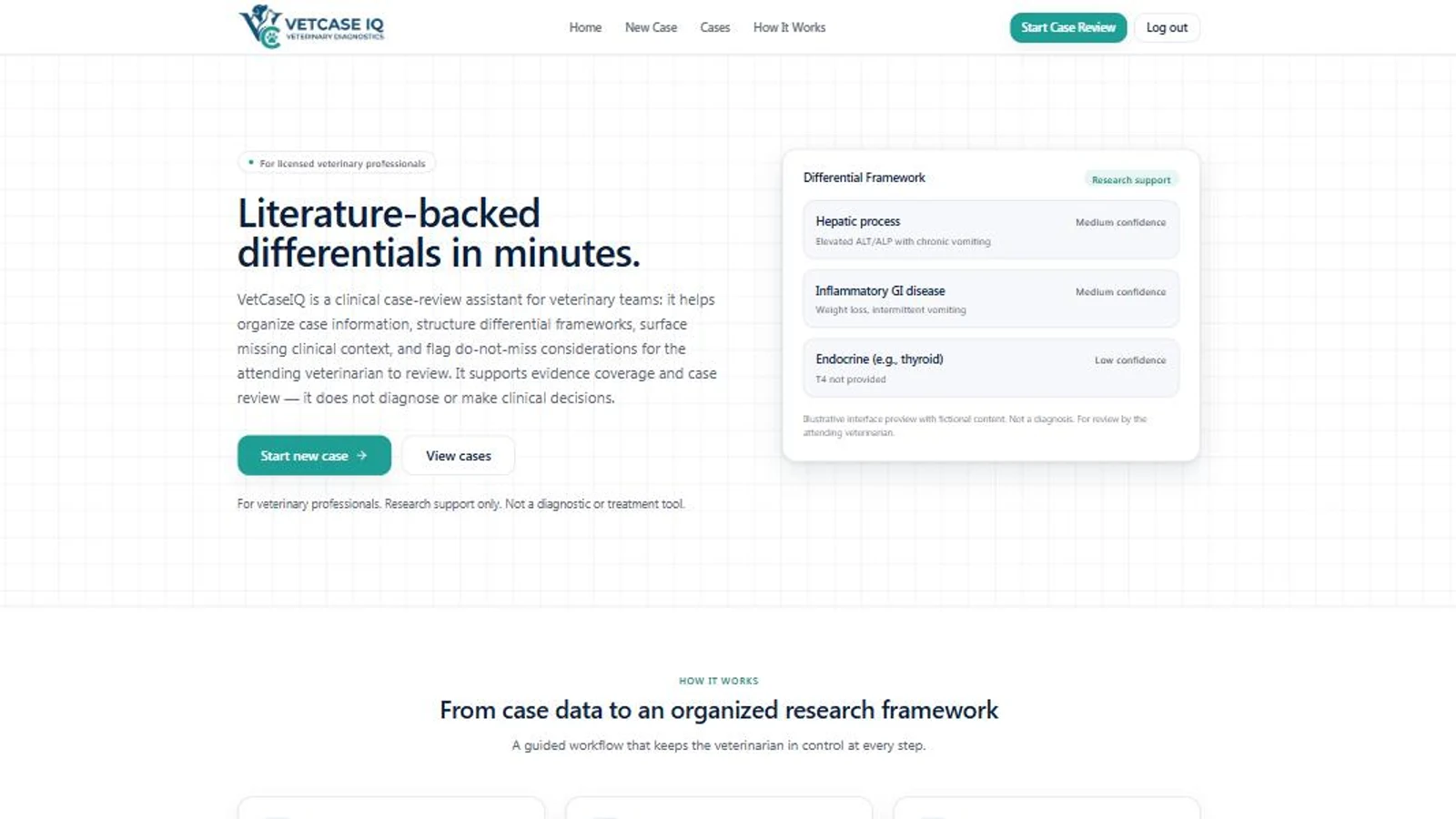
- Status
- LiveShipped and publicly available.
- Started
- Updated
- Role
- Founder, Product Design, Systems Architecture, QA & Validation, Deployment, Customer Discovery
- Built with
Overview
VetCaseIQ is a veterinary case-review application I began building around a simple idea: the patient record already exists, so a veterinarian should not have to manually rewrite the case into an AI prompt before getting a second structured review.
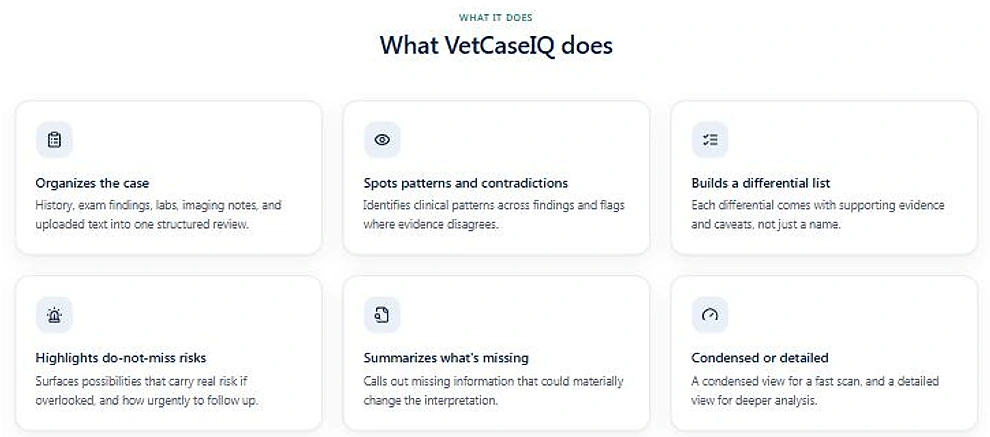
The core workflow is document-first. A clinic uploads the available records. VetCaseIQ extracts and organizes the case, identifies missing information, develops and reviews differential diagnoses, highlights important rule-outs, retrieves relevant veterinary literature, and produces a structured report for veterinarian review.
What began as “upload a record and generate a report” evolved into a multi-stage reasoning and validation system.
VetCaseIQ is deployed as a controlled beta. It is designed as research and decision support for veterinary professionals, not an autonomous diagnostic product, and its reports explicitly require veterinarian judgment.
Upload First. Questions Later.
Complex cases often contain the information needed for a strong second review, but it may be distributed across histories, laboratory reports, imaging, medications, and multiple visits.
The original workflow principle became:
Upload first. Questions later.
Instead of asking the user to reproduce information already present in the chart, VetCaseIQ reconstructs the case first and then asks targeted follow-up questions only where something appears genuinely missing.
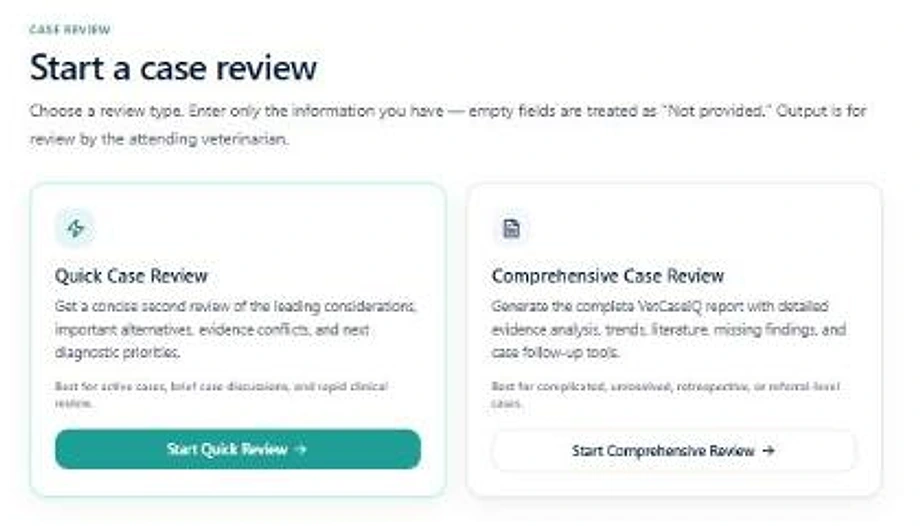
That changed the product from a chatbot interface into a document-processing and reasoning pipeline.
A Pipeline, Not One Prompt
The application is built with Next.js, React, TypeScript, and Node.js and runs on Hetzner behind Caddy.
Generative stages handle tasks that benefit from language-model reasoning: clinical extraction, candidate discovery, differential reasoning, QA, synthesis, and adjudication.
Deterministic stages handle claims the software can verify more directly.
Examples include:
- whether a report claim contradicts a laboratory value;
- whether a suggested diagnostic has already been performed;
- whether a do-not-miss flag has enough case-specific evidence;
- whether report sections contain duplicate items;
- whether literature actually made it from retrieval into the final rendered differential;
- whether later pipeline stages are silently increasing confidence without new evidence.
That last category became particularly important.
One Case, End to End
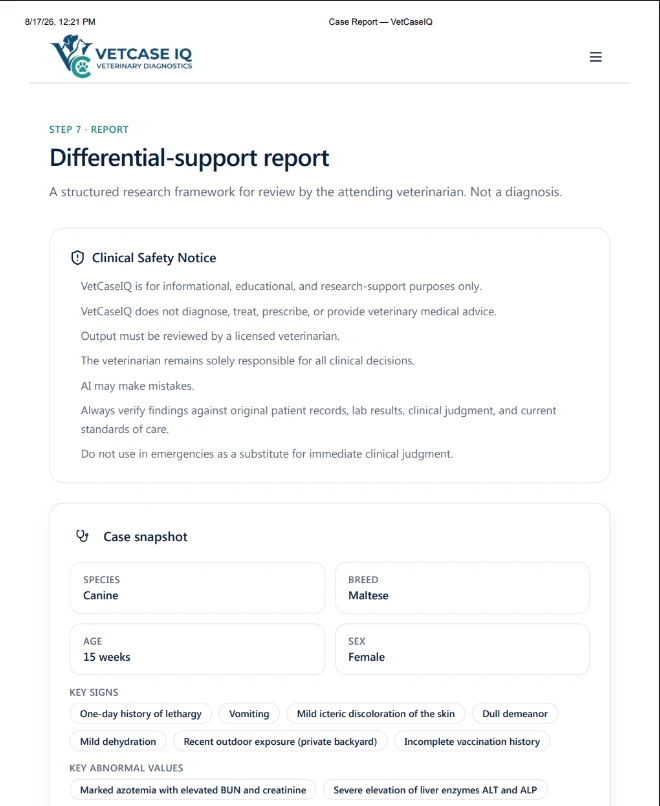
The clearest way to describe the output is to walk a single case through it. This one is a retrospective test case from the validation corpus: a 15-week-old Maltese puppy presented after one day of lethargy and vomiting, with icterus, marked azotemia, severely elevated liver enzymes, an inflammatory leukogram and an incomplete vaccination history. Everything below came out of the deployed system from the uploaded record.
The report opens by stating what it is not. The header, the safety notice and the case snapshot all land before a single differential, because the document is a research framework for the attending veterinarian rather than a diagnosis.
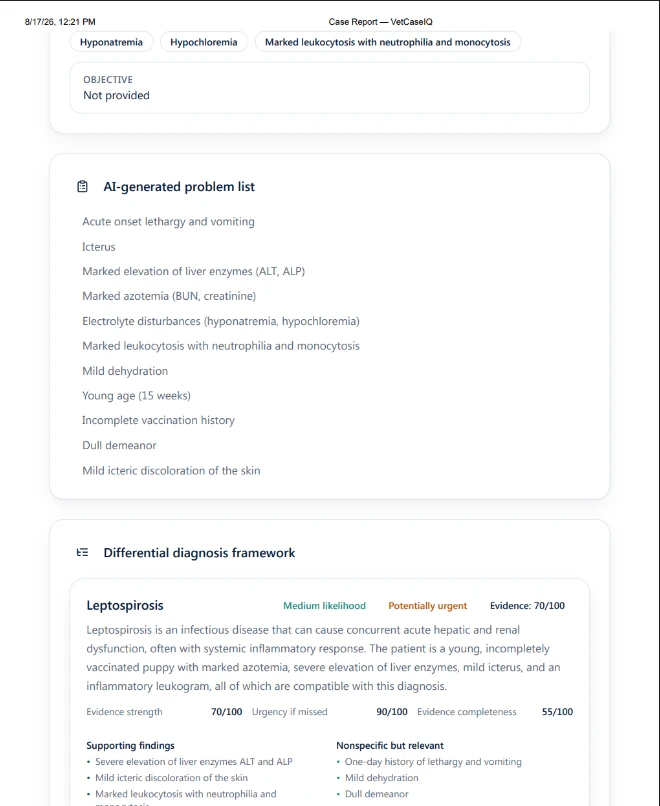
The differential framework follows the reconstructed problem list. Each candidate carries a likelihood, an urgency, and three separate scores: how strong the evidence is, how much it matters if missed, and how complete the evidence actually is. Splitting those apart is deliberate — a differential can be urgent and under-evidenced at the same time, and collapsing that into one confidence number is how a report starts sounding more certain than the case supports.
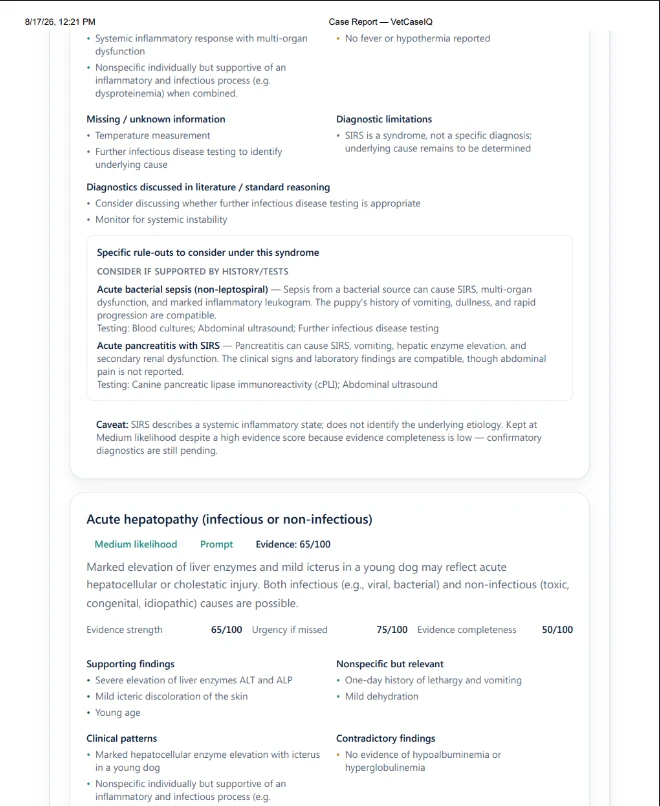
Rule-outs are attached to the differential they belong under, each with the testing that would settle it, and each with a caveat explaining why it sits where it sits.
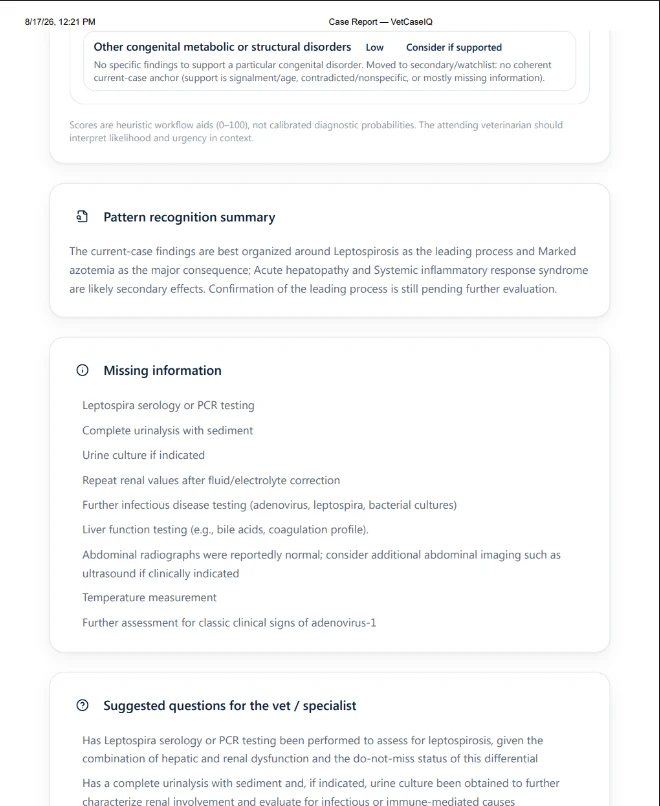
The report ends by being explicit about what it does not know. Missing information is a first-class section, not a hedge buried in the prose, and it feeds the suggested questions and the diagnostics worth discussing.
Preventing Later Stages from Undoing Better Reasoning
One test case showed a differential becoming more confident and gaining a do-not-miss flag after QA despite receiving no new discriminating evidence.
The prose still sounded reasonable. The pipeline state was not.
I added stage authority and promotion provenance so later stages cannot silently re-promote a candidate that an earlier reviewed stage had downgraded unless there is new evidence supporting that change.
That reflects a broader rule in VetCaseIQ: a polished final paragraph is not enough. The system has to preserve why a conclusion earned its position.
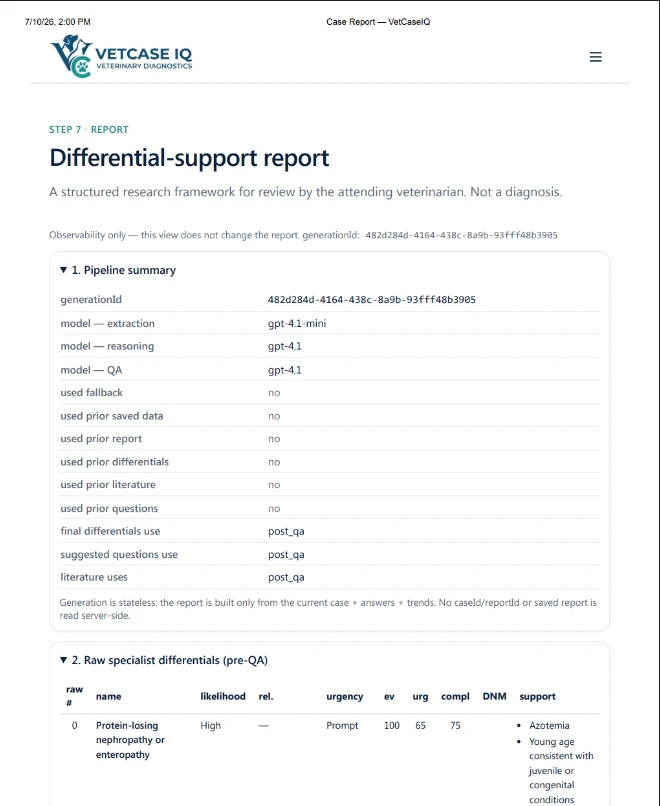
Every generation therefore keeps an observability view beside the report. It records which model ran which stage, whether any fallback or prior saved state was used, and which stage each published section was taken from — then prints the raw pre-QA differentials and the post-QA set side by side so a promotion or a demotion can be read directly instead of inferred from the finished prose.
Avoiding Benchmark Overfitting
Repeated testing makes disease-specific fixes tempting.
I explicitly moved away from disease-name boosts, fixture-specific ranking patches, or injecting known answers into candidate sets. Fixes are expected to improve generic evidence quality: contradiction handling, grounding, specificity, stage authority, evidence normalization, and provenance.
The goal is not to make one benchmark case pass. It is to make the reasoning rules more defensible across unfamiliar cases.
Literature Has to Survive the Whole Pipeline
VetCaseIQ retrieves veterinary literature through PubMed and Europe PMC and associates sources with individual differentials.
A useful failure mode was discovering that verified papers could be successfully retrieved but disappear or become disconnected from the final differential structure.
That reinforced a lesson repeated throughout the project: successful intermediate computation means very little if the user-visible final object is inconsistent.
The final validation layer therefore checks the rendered state, not just the existence of good intermediate data.
Measuring the Real Bottleneck
Report generation was also slower than the first instrumentation suggested.
One measured report took roughly 347 seconds, while the initial timing system accounted for only around 90 seconds of work. Most of the runtime was effectively invisible.
I rebuilt observability around request-scoped stages, model calls, and external API timing so performance work could be based on measured bottlenecks instead of guesses.
Development and Validation Workflow
VetCaseIQ is not a solo build. I lead product, workflow and operations, working with a small advisory team: Dr. Jacob Piñón, a resident physician, advises on clinical reasoning workflows and how complex case information is prioritized and communicated; Akshay Basi, an MD candidate, advises on structured case review and differential organization; and Maxon Bowman advises on data structure, reporting logic and analytics workflows.
Claude Code serves as the primary implementation agent, while I direct architecture, product behavior, test design, and clinical-output evaluation.
There is an important split in validation. The local coding environment can prove deterministic tests and builds, but it cannot execute the complete real API-powered report pipeline. A change therefore is not accepted merely because the code compiles.
The implementation agent passes the local regression suite; I deploy the change and run actual cases through the real system before accepting clinical behavior.
That separation became essential as the automated suite grew beyond 1,100 tests.
Current State
VetCaseIQ is a deployed controlled-beta application capable of completing the case-review workflow and producing multi-page reports from uploaded cases.
The core product works, and several independent test cases have produced the expected primary differential. The latest recovered workflow version was intentionally treated as a partial clinical-correctness release rather than a finished validation milestone.
The current work is about confidence, not feature count: provenance, literature consistency, hierarchy, evidence specificity, latency, additional independent cases, and more feedback from practicing veterinarians.
The goal is not to make the report sound more certain. It is to make every conclusion easier to trace back to the evidence that earned it.
Milestones
Document-first concept created
Started from the idea that clinics should upload the existing record instead of rewriting a case into an AI prompt.
Extraction and reasoning split into separate stages
Replaced the single-prompt approach with a document-extraction stage feeding a separate differential-reasoning stage, so a weak reconstruction could no longer hide inside a confident report.
Deterministic checks added around the generative stages
Introduced contradiction, duplicate and already-performed-diagnostic checks that run against the case data rather than the prose.
Stage authority and promotion provenance
Made every differential carry the stage that placed it, so a later stage cannot silently re-promote a candidate an earlier reviewed stage downgraded without new evidence.
Literature tied to individual differentials
Moved retrieval from a general reading list to sources attached to specific differentials, and added a check that they survive into the rendered report.
Per-generation observability view
Added a debug report recording stage models, fallback usage and pre-QA versus post-QA differentials for every generation.
Application deployed
Moved the end-to-end case-review workflow into a controlled-access deployed beta.
Validated against published Cornell cases
Ran retrospective testing against published eClinPath diagnostic-challenge cases from Cornell, using only the information available before the published diagnosis and comparing the top differential against it.
Customer discovery began
Started direct outreach to veterinary companies and clinics while continuing product validation.